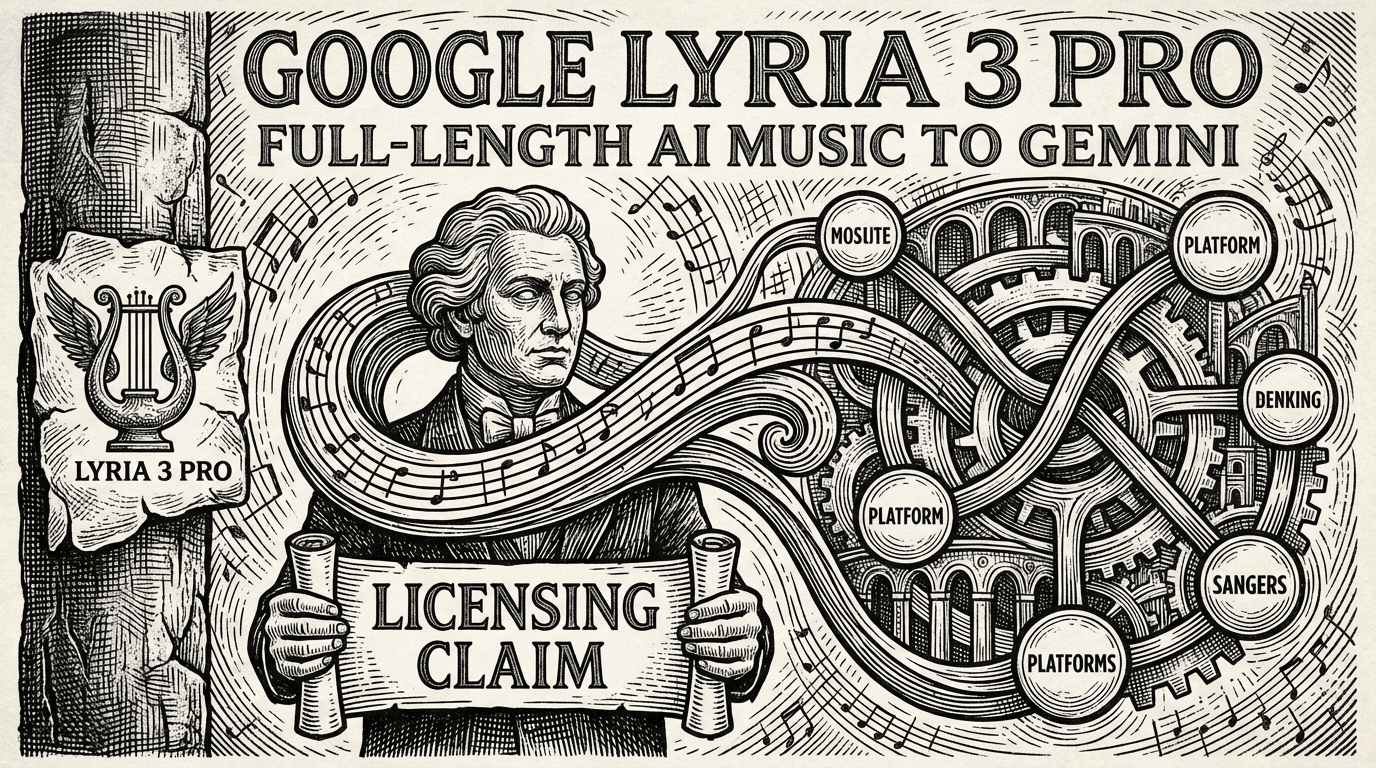
Google announced Lyria 3 Pro on March 25, 2026, less than a month after the original Lyria 3 model landed in the Gemini app. The new model arrived just a month after Lyria 3's release and lets users create tracks up to three minutes long, compared to the 30-second-long tracks offered with its predecessor. The jump is not merely quantitative. The Pro model introduces structural musical awareness that the base version lacked, making it a meaningfully different tool for anyone who needs more than a quick audio clip.
What Exactly Changed with Lyria 3 Pro
Apart from allowing users to create longer tracks, Lyria 3 Pro offers better creative control and customization. In the prompt, users can specify different elements of a musical piece, such as intros, verses, choruses, and bridges, as the model understands track structure better than its predecessor.
Google describes this as the model now understanding the architecture of music — a distinction that separates it from earlier AI music tools that generated audio as a continuous, undifferentiated stream. Being able to explicitly prompt for a verse or a bridge means creators can iterate on specific sections rather than regenerating an entire track every time something doesn't land.
Users can create 30-second tracks with Lyria 3 by selecting the "Fast" model, or create tracks up to 3 minutes long with Lyria 3 Pro by selecting the "Thinking" or "Pro" model. The prompt controls extend to instruments, vocals, and lyrics. Users can ask for specific sounds or solos to add texture to a track, specify gender, voice texture, and range for vocal delivery, and describe the topic, include personalized details, or provide their own text with structure tags.
Where Lyria 3 Pro Is Available
Lyria 3 Pro is available in Vertex AI, Google AI Studio, the Gemini API, Google Vids, the Gemini app, and ProducerAI. The simultaneous rollout across six platforms is notable and signals that Google is treating music generation as a cross-product infrastructure layer rather than a standalone feature.
Here is how access breaks down by platform:
Gemini App: Lyria 3 Pro is now available in the Gemini app for Google AI Plus (10 tracks/day), Pro (20 tracks/day), and Ultra (50 tracks/day) subscribers. Free users are not included at launch.
Google Vids: Vids is an AI-powered video creation app, and with Lyria 3 and Lyria 3 Pro in Vids, users can add custom music that matches their style for everything from creative projects to marketing videos. This is rolling out to Google Workspace customers and Google AI Pro and Ultra subscribers.
Vertex AI: Lyria 3 Pro is now in public preview on Vertex AI for businesses who require on-demand audio at scale, giving organizations the ability to scale high-fidelity production, from rapidly generating bespoke soundtracks for gaming to integrating into creative tools, music and video platforms.
Google AI Studio and Gemini API: For developers building the next generation of creative tools, Lyria 3 provides improved musical awareness and structural coherence to offer creative flexibility, and Lyria 3 Pro is now available alongside Lyria RealTime in AI Studio.
ProducerAI: ProducerAI is a collaborative music creation tool built by musicians looking for new ways to enhance their creative process. With Lyria 3 Pro, ProducerAI offers an agentic experience designed to help artists, producers, and songwriters at every level iterate on comprehensive songs, and it is available globally to free and paid subscribers.
The Training Data and Licensing Position
The most consequential aspect of this announcement may not be the three-minute ceiling. The more pointed detail in Google's announcement is not the capability upgrade — it is the explicit claim about training data. Google stated that Lyria 3 Pro was developed using materials the company has "a right to use under our terms of service, partner agreements, and applicable law," and every generated track carries a SynthID watermark.
This positioning is deliberate. Suno and Udio, the two AI music startups with the most consumer traction, are currently in active copyright litigation with major record labels over training data. Google is positioning Lyria 3 Pro as the licensed alternative for developers and businesses that cannot afford that legal exposure.
However, the claim deserves scrutiny. What Google will not disclose is what those partner agreements actually cover — which labels, which terms, which rights holders. The statement is carefully worded, and right to use under existing agreements is not the same as a clean copyright clearance across all downstream applications, with the lack of specifics leaving the claim harder to evaluate than the framing implies.
On the output side, to protect original expression, Lyria 3 and Gemini do not mimic artists; if a prompt names a creator, the model takes that as broad inspiration. Additionally, Google employs filters to check outputs against existing content, and users must adhere to the Terms of Service and Gen AI prohibited use policies, which prohibit violating others' intellectual property and privacy rights.
Artist Collaborations and Safety
Google has been building relationships in the music industry alongside the technical rollout. Grammy-winning producer Yung Spielburg used Lyria in his composition and production process for the score of the Google DeepMind short film "Dear Upstairs Neighbors," and Google is also collaborating with DJ and producer François K, who used Lyria in an iterative process to create a soon-to-be-released song.
Google uses extensive filtering and data labeling to minimize harmful content in datasets and reduce the likelihood of harmful lyrics. Audio generation in Lyria has the company's latest privacy and safety features, and all tracks are imperceptibly watermarked with SynthID technology, allowing detection of whether music has been created or edited using AI.
The SynthID watermarking is particularly relevant given the broader streaming context. The move comes as streaming platforms and digital service providers increasingly develop tools to detect and manage AI-generated music, amid concerns over synthetic or low-quality uploads flooding music catalogues.
What This Means in Practice
The practical shift here is that Lyria 3 Pro moves AI music generation from novelty territory into something usable for real content workflows. Lyria 3 Pro's enhanced customization offers more space to experiment and play with longer tracks, so users can add more details to bring their full vision to life, or create personalized tracks for vlogs, podcasts, or tutorial videos.
For developers and enterprise teams, the Vertex AI preview and Gemini API access open up programmatic music generation at scale — a capability that previously required third-party tools carrying legal uncertainty. The rollout for Lyria 3 Pro began on March 25, 2026, and is currently available globally for users over the age of 18 in several languages, including English, Spanish, French, and Japanese.
The gap between Lyria 3 and Lyria 3 Pro — roughly one month — reflects how quickly Google is iterating on this stack. The base model served as a consumer proof-of-concept; the Pro version is clearly aimed at capturing the creator and enterprise market before competitors consolidate their positions. Whether the licensing narrative holds up under scrutiny is a separate question, but the technical upgrade itself is real, and the distribution reach across Google's ecosystem gives it immediate scale that standalone AI music tools cannot easily match.
Frequently Asked Questions
What is Lyria 3 Pro and how does it differ from Lyria 3?
Lyria 3 Pro is Google's advanced music generation model that supports tracks up to three minutes long and understands song structure — including intros, verses, choruses, and bridges. The original Lyria 3 was limited to 30-second clips with less compositional control.
Who can access Lyria 3 Pro in the Gemini app?
Access is currently limited to paid Gemini subscribers. Google AI Plus subscribers get 10 tracks per day, Pro subscribers get 20, and Ultra subscribers get 50. Free users do not have access at launch.
Can Lyria 3 Pro replicate the style of a specific artist?
Google states the model does not mimic artists. If a prompt names a specific creator, the model treats that as broad stylistic inspiration rather than a direct replication.
How does Google handle copyright concerns with Lyria 3 Pro?
Google claims the model was trained on data it has the legal right to use under partner agreements and applicable law. All generated tracks are watermarked with SynthID to identify them as AI-created. However, Google has not publicly disclosed the specific partners or rights agreements involved.
Is Lyria 3 Pro available to developers and businesses?
Yes. Developers can access it through Google AI Studio and the Gemini API, while enterprise customers can use it via Vertex AI, currently in public preview. ProducerAI also uses Lyria 3 Pro and is available globally to both free and paid users.