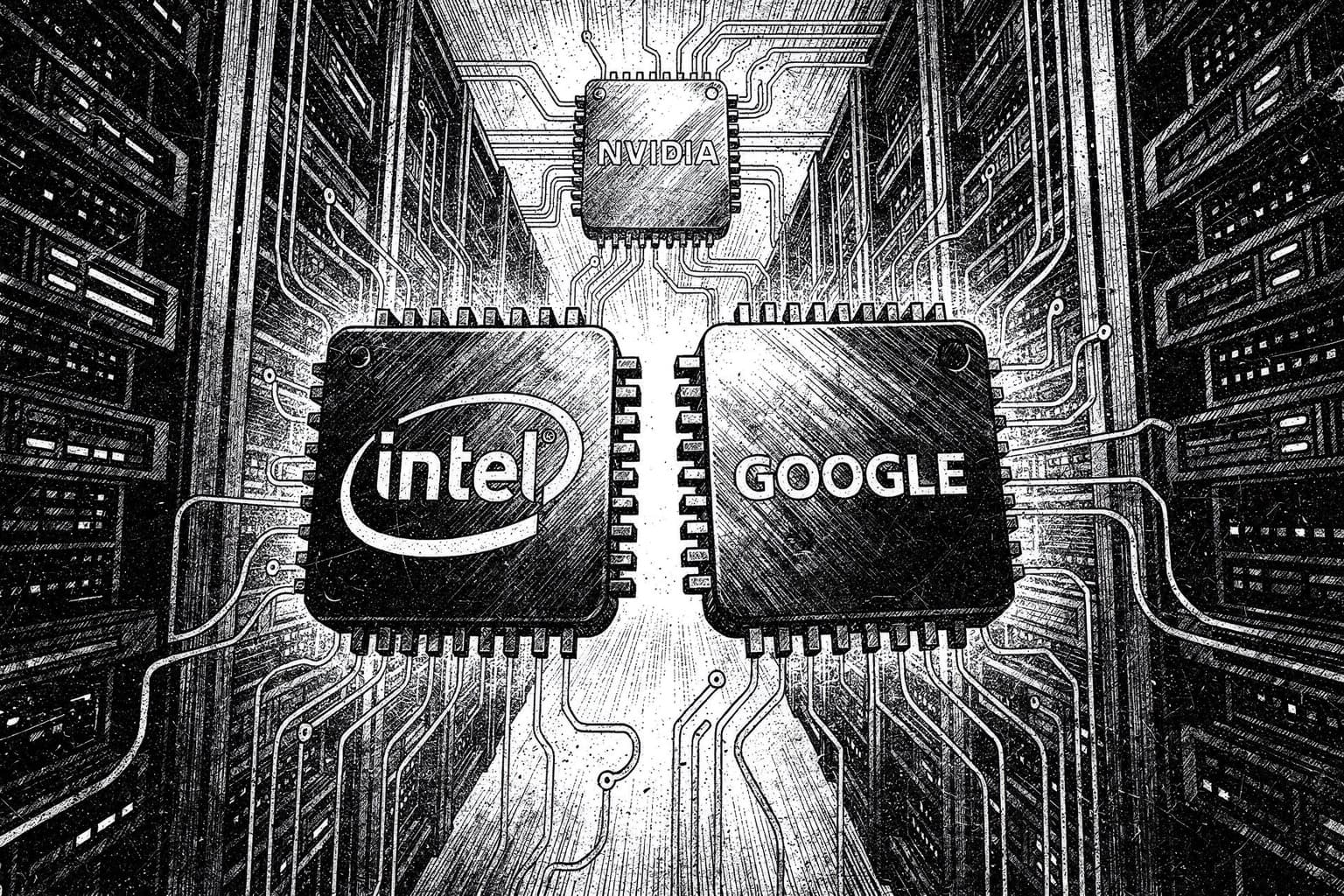
The race to build the most powerful and efficient AI infrastructure just got a major new alliance. Intel and Google Cloud have announced a significantly expanded partnership aimed at optimizing and scaling AI workloads for the future. This isn't just a new product launch; it's a strategic alignment of roadmaps, with Google planning to offer cloud instances powered by Intel’s upcoming Xeon 6 processors and Gaudi 3 AI accelerators later this year.
For anyone building or deploying large-scale AI models, this move signals a tangible shift. The AI hardware stack, long dominated by Nvidia’s integrated ecosystem of GPUs and CUDA software, is facing its most credible multi-front challenge yet. Google brings its deep expertise in AI software frameworks, massive-scale data center operations, and its own Tensor Processing Units (TPUs). Intel brings a renewed focus on AI-optimized CPUs and a competitive AI accelerator in Gaudi 3. Together, they are building an alternative stack designed for performance, openness, and scale. As someone who tracks the infrastructure layer closely, this collaboration feels like a pivotal moment where theoretical competition turns into a viable, enterprise-ready pipeline.
What This Expanded Partnership Entails
The collaboration is multifaceted, targeting both the immediate future and long-term architectural evolution. The most concrete near-term deliverable is Google Cloud’s commitment to launch instances featuring Intel’s next-generation hardware. This includes general-purpose compute instances powered by the upcoming Intel Xeon 6 processors (codenamed Sierra Forest and Granite Rapids) and, more critically, AI-optimized instances featuring the Intel Gaudi 3 AI accelerator.
Beyond hardware availability, the partnership involves deep software integration. The companies are working to ensure popular AI frameworks like TensorFlow and PyTorch run optimally on the Intel hardware stack within Google Cloud. This includes contributions to open-source projects and optimizing software libraries. A key focus is the OpenXLA compiler ecosystem, a project born from Google, which aims to make AI models portable across different types of hardware. By ensuring Gaudi and Xeon work seamlessly with these open software tools, Intel and Google are betting on an open, modular approach to challenge Nvidia’s more vertically integrated CUDA platform.
The Hardware at the Core: Xeon 6 and Gaudi 3
To understand the potential impact, we need to look at the silicon driving this effort.
Intel Xeon 6 represents a fundamental shift in Intel’s data center strategy. It will come in two distinct flavors: E-core (Sierra Forest) and P-core (Granite Rapids) variants. The E-core version is designed purely for high density and extreme efficiency in cloud-native and scale-out workloads—think running thousands of AI inference instances or microservices. Intel claims Sierra Forest will deliver 2.7x better performance per watt and 2.4x better rack density than the current generation. The P-core version focuses on high-performance per thread for more demanding tasks. This bifurcation allows Google Cloud to match the processor architecture precisely to customer workloads.
The Intel Gaudi 3 AI accelerator is Intel’s direct challenger to Nvidia’s H100 and upcoming Blackwell GPUs. According to Intel, Gaudi 3 will deliver a 4x increase in AI compute for BF16 precision, a 2x increase in memory bandwidth, and a 1.5x increase in networking bandwidth over its predecessor. Crucially, it is designed to excel at both training and inference for large language models. Benchmarks provided by Intel suggest Gaudi 3 will offer significant cost advantages, claiming it will train a 7-billion parameter model 1.7x faster than Nvidia’s H100 and deliver 50% faster inference for a 70-billion parameter Llama model. While real-world cloud performance remains to be seen, these specs position Gaudi 3 as a formidable contender.
Why This Collaboration Matters for the AI Industry
This partnership is significant for several reasons beyond the technical specs. First, it provides credible diversification. The AI boom has created an acute dependency on a single hardware vendor. For many enterprises, limited GPU availability has been a bigger bottleneck than ideas. Google Cloud offering a performant alternative like Gaudi 3 creates supply chain resilience and competitive pricing pressure.
Second, it champions an open and modular software approach. The collaboration’s emphasis on OpenXLA, PyTorch, and TensorFlow is a direct contrast to Nvidia’s CUDA ecosystem. While CUDA is powerful and entrenched, it locks developers into Nvidia hardware. Intel and Google are betting that the industry will prefer a future where models can be compiled to run optimally on any accelerator—be it TPU, GPU, Gaudi, or others—through open standards. Google’s Senior Vice President of Technical Infrastructure, Amin Vahdat, stated the goal is to “enable an open ecosystem that drives innovation and makes it easier for customers to take advantage of the latest AI capabilities.”
Third, it represents a full-stack optimization. Google isn’t just slotting Intel cards into its servers. The collaboration spans the entire stack: from the physics of chip packaging and cooling, through the data center power and rack design, up to the compiler and framework layers. This end-to-end co-design is what allows for true performance and efficiency breakthroughs, and it’s an area where Google’s unparalleled data center experience is a massive force multiplier for Intel’s hardware.
The Competitive Landscape and What’s Next
The immediate target is clear: Nvidia’s dominance in AI training and inference. But the collaboration also positions Intel and Google against other cloud-specific AI chips, like Amazon’s Trainium and Inferentia, and of course, Google’s own TPUs. The strategy appears to be one of “and,” not “or.” Google will offer a portfolio of AI accelerators—TPU, GPU, and now Gaudi—allowing customers to choose based on the specific needs of their model and budget.
The success of this venture hinges on execution. Intel must deliver Gaudi 3 on time and at scale, meeting its performance promises. Google must integrate it flawlessly into its cloud fabric and convince developers to port their workloads. Early access for the new instances is expected in the second half of 2024. The market will be watching closely for independent benchmarks and total cost of ownership analyses.
Final Thoughts
This deepened Intel-Google alliance is one of the most consequential infrastructure developments of the year. It’s a move that goes beyond a simple vendor agreement; it’s a strategic coalition formed to shape the next decade of AI compute. By combining Intel’s ambitious silicon roadmap with Google’s cloud scale and software prowess, they are constructing a credible, open alternative to the status quo.
For developers and enterprises, this means more choice, potentially lower costs, and a healthier, more innovative ecosystem. The era of a single, monolithic AI hardware stack is being challenged. The real winner here is the pace of AI itself, as competition tends to fuel rapid advances in performance, efficiency, and accessibility. I’ll be keenly watching the first benchmarks from Google Cloud instances later this year—that’s when the promise will meet the proof.
What’s your take? Is an open software ecosystem enough to shift developer habits away from CUDA, or does Nvidia’s lead remain insurmountable?
FAQ
What are the key products from Intel in this collaboration? The collaboration centers on Intel's upcoming Xeon 6 processors (both E-core and P-core variants) for general compute and, most importantly, the Intel Gaudi 3 AI accelerator for training and running large AI models.
When will Google Cloud offer instances with this new Intel hardware? Google Cloud has stated it plans to launch instances featuring Intel Xeon 6 processors and Gaudi 3 AI accelerators in the second half of 2024, with early access programs likely coming first.
How does the Intel Gaudi 3 compare to Nvidia's H100 GPU? Based on Intel's provided figures, Gaudi 3 claims to offer 4x more AI compute (BF16), double the memory bandwidth, and 1.5x the networking bandwidth of Gaudi 2. Intel benchmarks project it to train and infer large language models faster and at a lower cost than the H100, though independent third-party validation in a cloud setting is still pending.
What is the significance of the OpenXLA compiler in this partnership? OpenXLA is an open-source compiler ecosystem that allows AI models to run efficiently on different types of hardware (TPUs, GPUs, CPUs, etc.). The partnership's focus on optimizing for OpenXLA is a strategic push for an open, portable software stack as an alternative to Nvidia's proprietary CUDA platform.
Why would a customer choose Intel Gaudi on Google Cloud over Nvidia GPUs or Google TPUs? The primary potential advantages are cost-effectiveness, increased supply chain diversity, and the benefits of an open software ecosystem. Customers may choose Gaudi instances if they demonstrate a better total cost of ownership for their specific workloads or if they prioritize avoiding vendor lock-in to a single hardware architecture.