
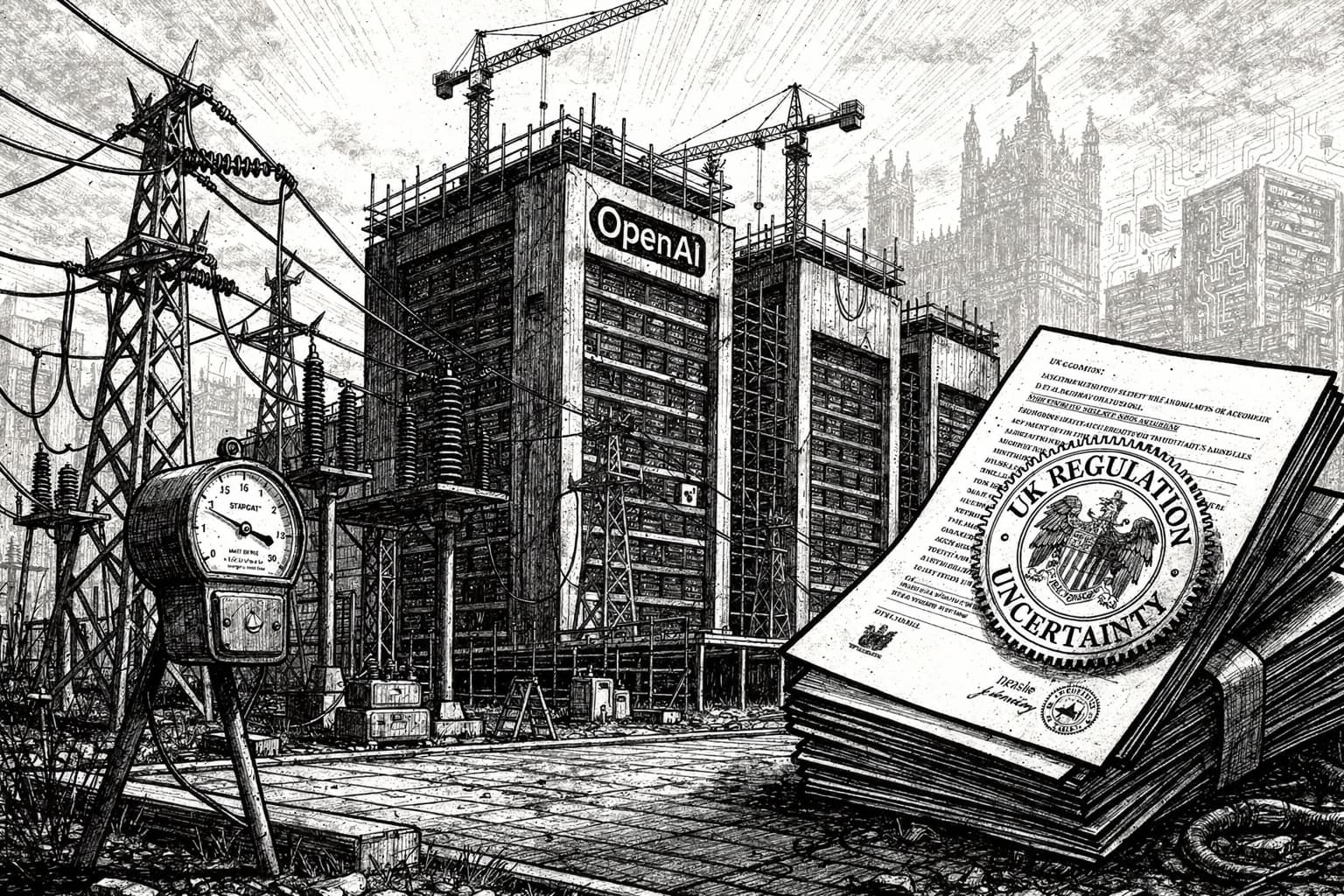
OpenAI has paused its planned Stargate buildout in the United Kingdom. The company points to high electricity costs and the regulatory environment as the reasons it cannot commit capital on the original timeline. The decision is a setback for the UK’s push to host more AI compute. (theguardian.com)
In a statement shared with multiple outlets, OpenAI said it will “move forward when the right conditions such as regulation and the cost of energy enable long term infrastructure investment.” That maps to what I have heard from other AI infrastructure teams that are comparing sites across the US, Europe, and the Gulf. Electricity price stability and clear approvals often decide the winner. (engadget.com)
The UK pitch had weight. Coverage last year described a package that included a large Northumberland facility and access to thousands of GPUs through partnerships that reportedly involved Nvidia and Nscale. The figure attached to the broader UK vision reached £31 billion across projects. Pausing that vision is not fatal, but it is material. (theguardian.com)
What is Stargate?
Stargate is OpenAI’s long horizon infrastructure program for AI compute. It anchors dedicated data center campuses, power upgrades, and multi year supply deals for accelerators. Earlier reporting tied Stargate to Oracle, SoftBank, and other partners, with projects in the United States and exploratory efforts overseas. (techradar.com)
The UK phase, often referred to as Stargate UK, was framed as a way to expand compute near customers and institutions that need data locality. It also aligned with rhetoric about “sovereign compute,” where countries want assured access to AI capacity inside their borders. (theguardian.com)
Why the pause now
Two forces converged. First, power is expensive in Britain by global industrial standards. Industry groups and official statistics have shown the UK near the top of the pack for industrial electricity prices among IEA members in recent periods. Second, the regulatory picture for very large data centers remains in motion, from planning to grid connection prioritization. OpenAI chose not to lock in a schedule until both stabilize. (eiug.co.uk)
OpenAI also appears to be recalibrating its wider infrastructure map. Reports in March noted that planned expansion at the Abilene, Texas campus would not proceed to the original scale, with capacity growth shifting to other US sites. A pause in the UK fits that pattern of re sequencing rather than a retreat from AI compute. (techradar.com)
Energy economics in the UK
For data centers, the input that dominates the P and L is electricity. A hyperscale AI site can draw hundreds of megawatts. In Britain, household tariffs get headlines, but the relevant signal for operators is industrial power pricing and long term contracts that sit on top of wholesale volatility. The Energy Intensive Users Group has highlighted that UK industrial electricity prices have ranked among the highest in the IEA, even after support schemes, which dents site competitiveness for power hungry AI clusters. (eiug.co.uk)
There are countervailing efforts. The regulator has cut the energy price cap for households for April to June 2026, reflecting lower wholesale prices in recent months. That helps consumers, but it does not solve industrial pricing for a 24x7 compute campus. Without direct power purchase agreements and dedicated grid upgrades, the math still looks hard relative to peer locations. (ofgem.gov.uk)
OpenAI has tried to address this in other regions by committing to fund local energy infrastructure that shields the public from bill impacts. The company said in January it would pay for energy related upgrades at Stargate sites. That tool could re enter the UK conversation if conditions improve. (bloomberg.com)
The regulatory picture
The UK has taken a flexible, regulator led approach to AI policy, while also promising to speed data center approvals. At the same time, the country has been overhauling grid connection rules after an avalanche of speculative applications clogged the queue. Government and the National Energy System Operator have moved to prioritize viable projects and to clear out stalled ones. That is progress, but developers still want predictable milestones from planning consent to interconnection dates before they pour concrete. (gov.uk)
Environmental scrutiny is also growing. Campaign groups and industry voices are pushing for stronger disclosure of emissions and water use for new facilities. Operators can meet those bars, but it adds work to an already complex approval path. For a program like Stargate that thrives on standardization and speed, uncertainty becomes a line item. (itpro.com)
Key technical and strategic notes
- The paused UK plan sat within a multi year push to add AI compute capacity at scale, often measured in gigawatts of power and tens of thousands of accelerators per campus. (techradar.com)
- UK reporting pegged the broader investment narrative around the country at up to £31 billion, including data centers and related supply chain commitments. (theguardian.com)
- OpenAI’s statement leaves the door open. It says it will proceed when the cost of energy and regulation support long term investment. (engadget.com)
- The government has signaled intent to prioritize data center grid access and to cut speculative connections, which could shorten timelines for shovel ready AI sites. (itpro.com)
- Parallel reporting suggests OpenAI is not exiting infrastructure, but redistributing growth among US locations while it monitors overseas options. (techradar.com)
What this means for the industry
If you are building AI products, the headline risk is not that compute vanishes. It is that new capacity lands later or in different places than expected. A pause in one country can redirect orders to another, which affects where AI jobs, research partnerships, and supplier contracts show up in 2026 and 2027. Semafor also noted a focus shift at OpenAI toward enterprise and coding use cases, which often pairs with data center footprints that favor lower power costs and faster approvals. (semafor.com)
For the UK, this is a signal to double down on two levers. Lock in industrial power deals that make round the clock electrons competitive with US and Gulf peers. Finalize a stable, faster path for permitting and grid connections for strategic sites. The government has already moved to prioritize data centers in connection queues. The next step is execution that developers trust. (techradar.com)
Why you should care
- AI teams in the UK may face a tighter local supply of high end compute if new domestic capacity slips, which can raise prices or push workloads to distant regions. (theguardian.com)
- Startups that need data residency in Britain could see fewer near term options and may need to architect around cross border latency and compliance. (theguardian.com)
- Policymakers will use this as a case study on how energy and planning policy shapes AI competitiveness, not just model policy. That debate will shape where the next clusters land. (itpro.com)
Final Thoughts
This pause is not about hype cycles in AI. It is about physics and policy. Power that is cheap, clean, and firm beats rhetoric every time. If Britain wants more AI compute, it needs to make those three words true for operators that commit billions on decade long horizons. The reforms on grid connections are a start, but pricing and certainty close the deal. (energyvoice.com)
From my seat, the interesting thread is not whether OpenAI returns to the UK. It is how fast governments can translate intent into bankable terms for AI infrastructure. I will watch for concrete progress on long term power contracts, timely interconnection offers, and planning timelines that match the cadence of AI demand. That is where this story moves next. (itpro.com)
FAQ
Is Stargate canceled in the UK?
No. OpenAI has paused the UK phase and says it may proceed when energy costs and regulation support long term investment. (engadget.com)
Did OpenAI stop building data centers entirely?
No. Reporting indicates a re sequencing of projects, including scaling plans in the United States, not a full stop. (techradar.com)
Why are UK electricity costs such a problem for AI sites?
Industry groups report UK industrial power prices among the highest in IEA members, which makes round the clock AI workloads expensive. (eiug.co.uk)
What UK regulatory issues affect AI data centers?
Planning approvals and grid connection queues are the main friction points. Government is moving to prioritize viable projects and clear the backlog. (itpro.com)
Could OpenAI return to the UK plan this year?
Possibly, if the power cost outlook and the approvals path improve enough to support long term commitments. OpenAI’s statement keeps that option open. (engadget.com)
title: "OpenAI pauses UK Stargate as energy costs and rules bite" subtitle: "OpenAI put its UK Stargate data center on hold, citing high electricity prices and regulatory uncertainty while it reassesses where to place long term AI compute." slug: "openai-pauses-uk-stargate-as-energy-costs-and-rules-bite" author: "Jim Clyde Monge" category: "ai-news" publishedAt: "2026-04-10T12:00:00Z" featured: false mainImage.alt: "OpenAI Stargate UK data center plans paused over energy costs and regulation"